
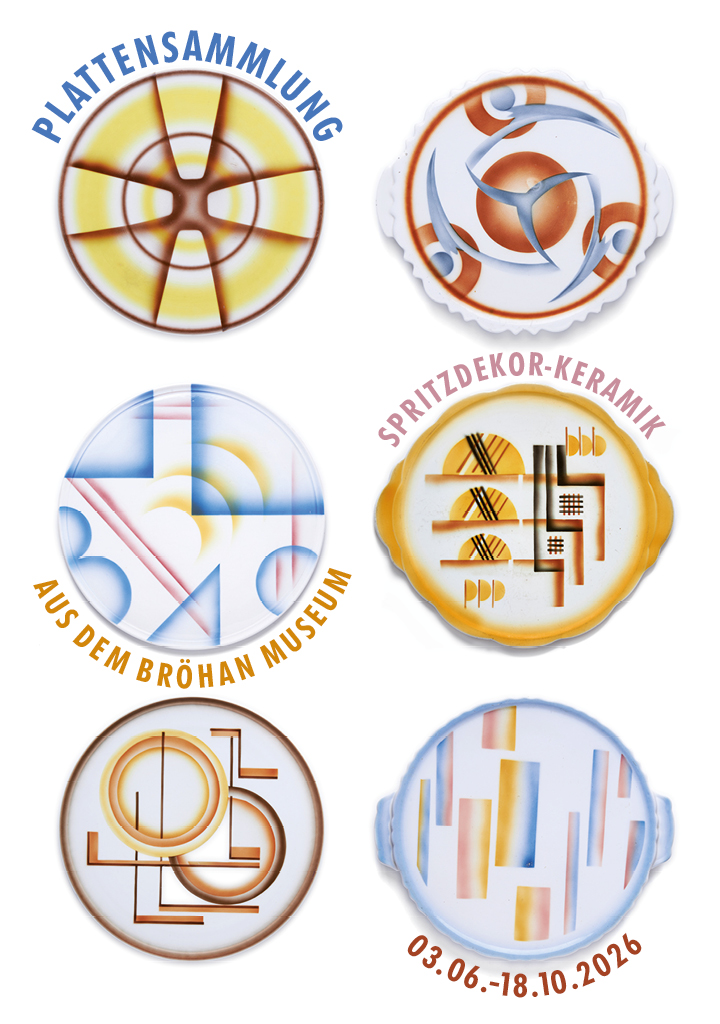
Plate Collection: Spray-Decorated Ceramics from the Bröhan Museum
03 June 2026 until 18 October 2026Bright Colours, Geometric Patterns, and Avant-Garde Forms: The collection of the Bröhan Museum comprises more than 350 cake plates. Almost all date from the era of the Weimar Republic and reflect influences from Art Deco, the Bauhaus, Cubism, and Constructivism. They tell a story not only of design but also of everyday life, revealing how modern art found its way onto the domestic coffee table.
The exhibition explores the rise of the cake plate in Germany from the 1920s to its peak around 1930. During this period, gathering for coffee and cake at home became an important social ritual among the growing middle class. A carefully laid table served as a means of self-expression, while tableware became a marker of taste and modernity.
At the same time, mechanised production methods made affordable mass-produced ceramics widely available. The ceramics industry expanded rapidly, developing a remarkable variety of new forms and decorative designs. In particular, the colourful spray decoration (Spritzdekor), applied with the aid of stencils, opened up a wide range of creative possibilities. As a result, the cake plate evolved from a luxury object into an affordable everyday item and a symbol of modern consumer culture.
The works on display come predominantly from the collection of Fritz Zuschlag and Bodo Wieneke-Zuschlag, which was donated to the Bröhan Museum in 2022.
Advertising motif:: from left to right at the bottom: Annaburger Steingutfabrik; Steingutfabrik Theodor Paetsch; Unknown manufacturer,teingutfabrik Colditz; Steingutfabrik Sörnewitz-Meißen; Unknown manufacturer, cake plates circa 1930, Bröhan Museum, Photo: Colya Kärcher, Berlin, Design: Gerwin Schmidt, 2026